
How to Use the Call-and-Response Tracks
The Functional Ear Training Call-and-Response tracks are designed to help you recognize and internalize the sound of individual scale degrees within a tonal context.
Rather than identifying isolated intervals, the idea is to develop a feeling for how each note relates to the tonic — the musical home base.
The Basic Idea: Listen and Respond
The exercises follow a simple call-and-response principle.
Listen to the notes being played or sung in the recording. Then, during the space provided for your response, sing them back.
You can use scale-degree numbers (1, 2, 3, etc.), movable-Do solfege syllables (Do, Re, Mi, etc.), or simply sing the notes without naming them.
The important thing is to connect what you hear with your own voice and gradually become familiar with the characteristic sound of each scale degree.
Three Versions of Each Exercise
The collection contains 36 tracks covering all twelve keys, with three versions in each key:
- Instrumental: The notes are played on an instrument, without sung scale-degree names.
- Nashville Numbers: The notes are sung using scale-degree numbers (1, 2, 3, etc.).
- Solfa: The notes are sung using movable-Do solfege syllables (Do, Re, Mi, etc.).
All three versions in a given key use exactly the same sequence of notes.
This allows you to practice the same exercise in different ways without having to learn a new sequence each time.
Getting Started
A good starting point is to choose a key that feels comfortable for your voice.
Begin with the Nashville Numbers or Solfa version. Listen to each call and repeat it during the response.
The sung versions help you associate the sound of each note with its scale-degree name.
Once you become familiar with the exercise, switch to the instrumental version in the same key.
Now try to recognize the notes yourself and respond by singing their scale-degree numbers or solfege syllables.
This is a more demanding exercise because the recording no longer tells you which scale degrees you are hearing.
Practice in Different Keys
The collection includes exercises in
In your download package you will find 36 tracks – three in each key.
The individual key is indicated right after the hyphen in the file name.
The call notes are either played by an instrument (“Instrumentalized call”) or vocalized by a singer (“vocalized call”). The singer sings either the number of the function, e.g. “One” or “Three” (Nashville Number System) or “Do” or “Mi” (Solfage or movable Do).
The three tracks in the same key are IDENTICAL – clarinet and singer sing the exact same notes. After the call it’s your turn – sing or play the response.
FUNCTIONALLY all 36 tracks are the same. Instrument and singer sing the exact same call notes functionally. It’s the key that changes.
The functions are the same.
Example: The singer/instruments sings/plays note 1 and 3 resp. Do and Mi. When D=1 that means they are singing/playing D and F#. When Eb=1 they are singing/playing Eb and G.
All 36 tracks are recorded individually; they are not generated by automatic transposition.
Challenge:
If you are up for a challenge, listen to an instrument track and sing the response with solfa syllables or scale degrees 😊
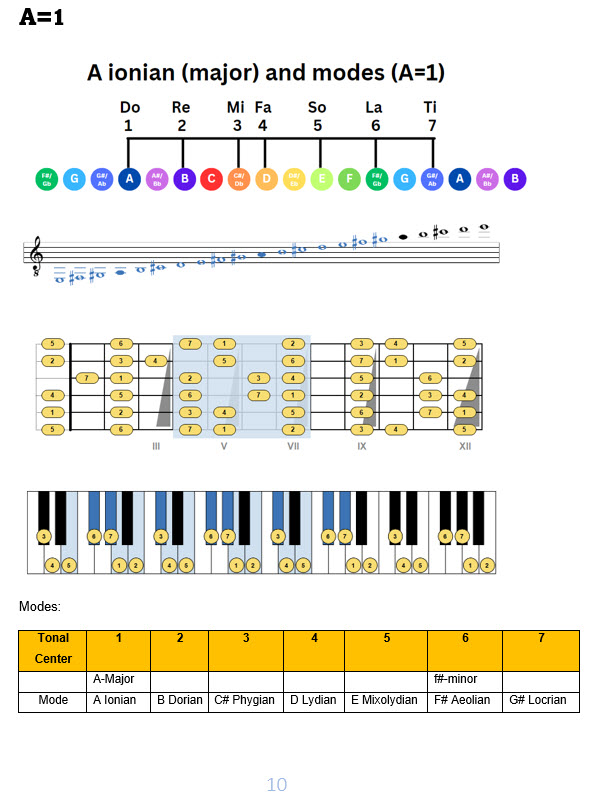
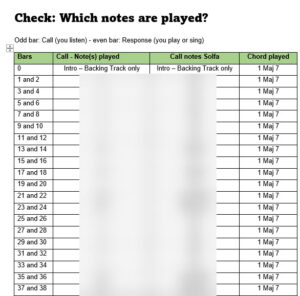
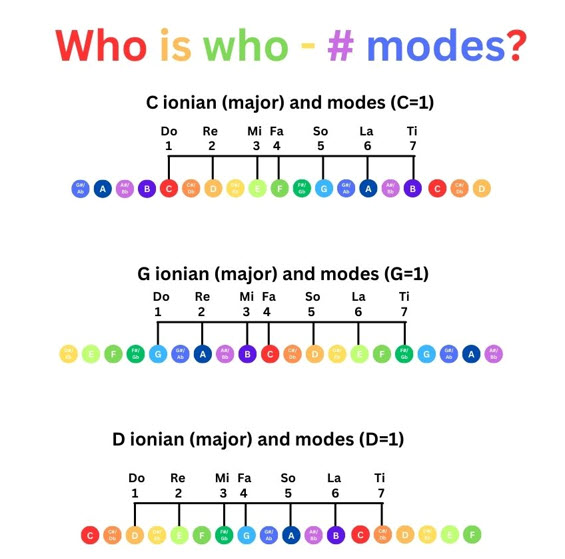
You will also get a PDF-Document with some witty infographics:
 One of the best ear training methods I’ve encountered is functional ear training.
With functional ear training, you focus on learning the specific sound of a note in the context of tonality instead of learning to recognize the sound of individual intervals.
Instead of identifying intervals, the goal of functional ear training is to figure out how the note in question relates to the key center.
That way you need not only the “note in question” but also a reference point – be it a drone, a backing track, or a background chord.
One of the best ear training methods I’ve encountered is functional ear training.
With functional ear training, you focus on learning the specific sound of a note in the context of tonality instead of learning to recognize the sound of individual intervals.
Instead of identifying intervals, the goal of functional ear training is to figure out how the note in question relates to the key center.
That way you need not only the “note in question” but also a reference point – be it a drone, a backing track, or a background chord.