
Three notes, five notes, or all seven? Instrumental calls, Nashville Numbers, or Solfa? Here’s how to find a good starting point for your functional ear training.
If you’ve had a look at the FET Call-and-Response collections, you may have noticed that there are several different sets of exercises.
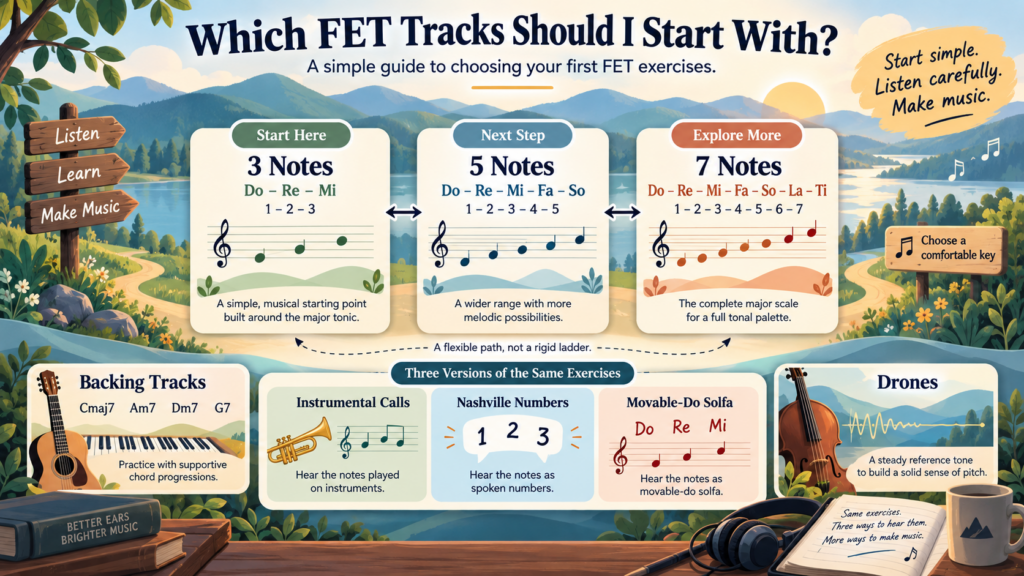
Some use only three scale degrees. Others use five or all seven notes of the major scale. And each collection offers three different ways of hearing the same musical phrases.
So where should you begin?
The short answer: Start with a small selection of notes in a comfortable key, and choose the version that gives you the amount of help you need.
You don’t have to work through every collection in a particular order. The idea is to find exercises that allow you to listen carefully, recognize musical relationships, and actively make music.
1. A Good Starting Point: Just Three Notes
If you’re new to functional ear training, I suggest starting with the collection 1 Maj7 only – notes 1 (Do), 2 (Re) and 3 (Mi).
This collection uses only the first three degrees of the major scale:
- 1 – Do: the tonic, your musical home base
- 2 – Re: the second scale degree
- 3 – Mi: the major third
For example, in C major, these are C, D, and E.
The notes are heard against a major seventh chord built on the tonic.
Why start with just three notes?
Because you can concentrate on getting to know the characteristic sound of each note without having to distinguish between seven different possibilities.
Listen to how Do relates to the underlying harmony. Notice the different quality of Re and Mi. Try to hear each note as a particular scale degree, rather than simply as a pitch that happens to be higher or lower than the previous one.
With only three notes, the musical material is limited, but there’s still plenty to explore.
Starting with fewer notes doesn’t mean you’re doing something trivial. It simply gives you fewer things to distinguish at once.
2. Which Version Should You Choose?
Every FET Call-and-Response collection provides three versions of the exercises.
The musical note sequences are the same, but the calls are presented differently.
Nashville Numbers – Hear the Scale-Degree Names
In the Nashville Numbers version, a singer performs the call using numbers such as “One”, “Two”, and “Three”.
You hear both the pitches and their scale-degree names.
This can be particularly useful when you’re still learning to associate the characteristic sound of each note with its function.
Listen to the call, then sing the same numbers during the response.
You are practicing the connection between the sound, the name, and your own voice.
Movable-Do Solfa – Do, Re, Mi
The Solfa version works in much the same way, but uses movable-Do syllables.
Instead of “One, Two, Three”, you’ll hear “Do, Re, Mi”.
If you already use movable-Do solfège, this version may feel more familiar.
Neither naming system is inherently required for functional ear training. Both provide a way to identify and sing scale degrees.
Choose whichever system you prefer — or experiment with both.
Instrumental Calls – Recognize the Notes Yourself
In the instrumental version, the calls are played by an instrument without naming the notes.
This changes the task.
You now have to identify the scale degrees yourself if you want to respond using numbers or Solfa syllables.
For example, you hear a short phrase and try to recognize it as:
Do – Mi – Re – Do
Then you sing those notes during the response.
Of course, you can also reproduce the phrase without naming the notes. But if your aim is to connect the sounds with their scale-degree identities, singing the names can be particularly useful.
My suggestion: Try a sung version first, then switch to the instrumental version of the same exercise.
That way, you can explore the same musical material with and without the scale-degree names being supplied.
3. Choose a Comfortable Key
The Call-and-Response collections include exercises in all twelve keys.
Functionally, the exercises remain the same. The notes are transposed, but their relationships to the tonic and the underlying harmony are preserved.
For example:
| Scale degree | In C major | In D major |
|---|---|---|
| 1 – Do | C | D |
| 2 – Re | D | E |
| 3 – Mi | E | F |