
You don’t need a piano, a computer, a home studio, or even a proper practice room to work on your musical ear. Sometimes, three small things are all it takes: a smartphone, a cheap digital wind instrument, and a pair of headphones.
That’s my minimal digital setup for Functional Ear Training. It’s inexpensive, portable, and surprisingly practical.
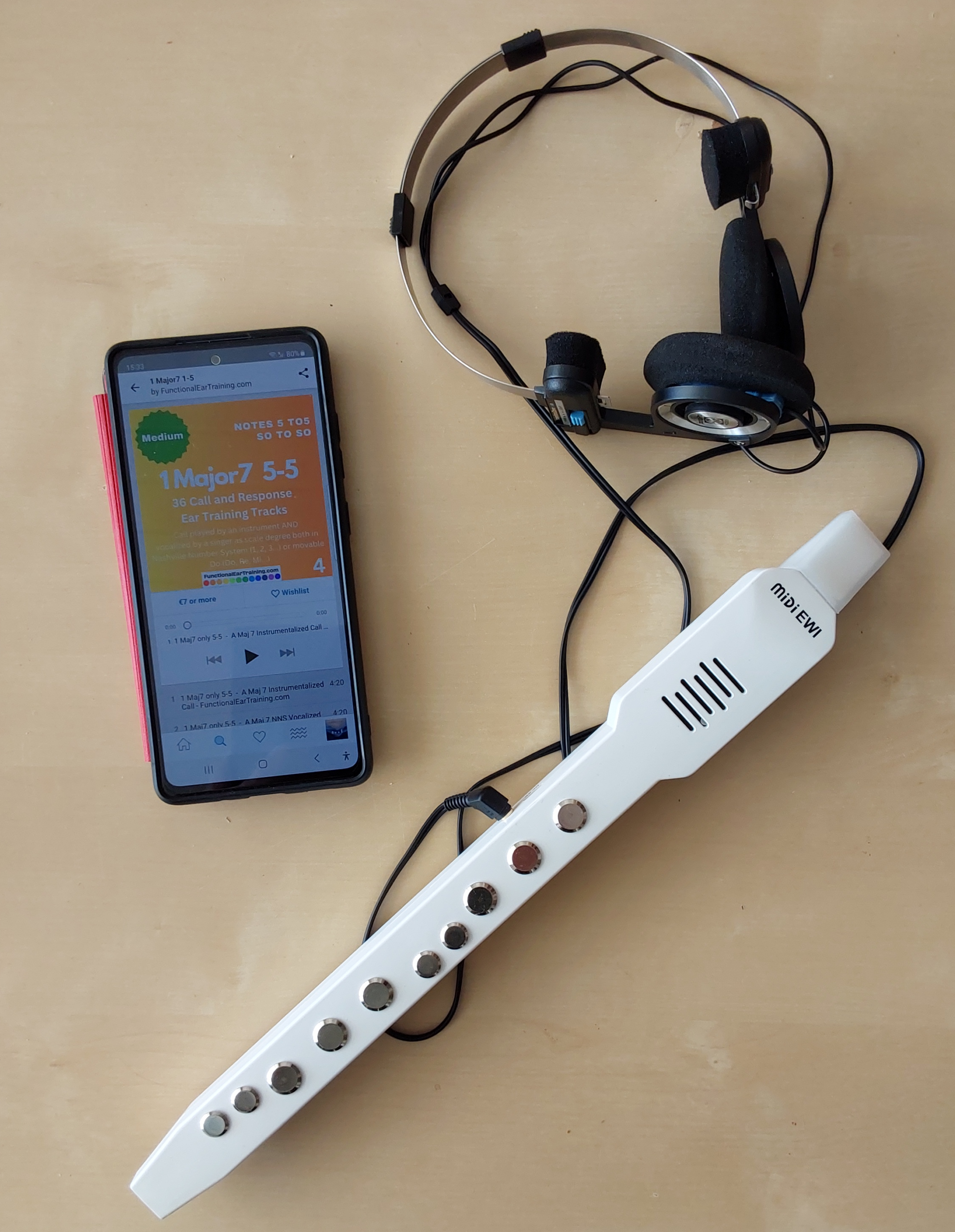
Three Pieces of Equipment – That’s It!
As you can see in the picture, my entire setup consists of:
- My smartphone – playing the Functional Ear Training Call-and-Response tracks.
- A cheap digital wind instrument – this little gadget from Amazon, which cost me very little money.
- A pair of headphones – so I can hear everything without disturbing anyone around me.
That’s the whole setup. No audio interface, no mixer, no laptop, no complicated wiring.
And the best part? Everything fits into a small bag.
The Trick: The Instrument Is Also a Bluetooth Speaker
Here’s what makes this combination so convenient.
The digital wind instrument isn’t just something you can play. It also functions as a Bluetooth speaker.
I connect my smartphone to the instrument via Bluetooth and start playing one of my Functional Ear Training practice tracks.
The audio from my phone is transmitted directly to the instrument. When I play along, the instrument combines the incoming practice track with the notes I’m playing.
Both signals go to my headphones.
I hear the practice track and my own playing together – directly in my ears.
No external speakers, no additional equipment, and no complicated setup.
Functional Ear Training Without Singing
The traditional way of using my Call-and-Response tracks is to listen to a musical phrase and sing it back during the response section.
But singing isn’t the only option.
You can also respond by playing the notes on an instrument. And that’s exactly what I do with this little digital wind instrument.
I listen to the call, identify the scale degrees by ear, and then try to reproduce them on the instrument.
This adds an interesting dimension to the exercise: instead of translating what I hear into my singing voice, I translate it into finger movements.
Of course, playing the correct notes on an instrument isn’t exactly the same skill as singing them. But both can be useful ways to practice recognizing scale degrees within a tonal context.
And sometimes, I simply enjoy playing along.
Practice Wherever You Happen to Be
What I particularly like about this setup is that it doesn’t require a dedicated practice session in a dedicated practice space.
I can use it:
- While traveling or staying in a hotel.
- On vacation, without taking a full-sized instrument.
- While babysitting, when there’s some quiet time.
- On the sofa, without setting up any equipment.
- Pretty much anywhere I have my phone, headphones, and a few spare minutes.
The headphones are especially useful when I don’t want to disturb other people.
It’s a very low-effort way to squeeze a little ear training into everyday life.
Does It Have to Be This Particular Instrument?
Absolutely not.
My digital wind instrument is a cheap little gadget, not a sophisticated professional instrument. I don’t expect it to compete with expensive electronic wind controllers.
For this particular purpose, it doesn’t have to.
What matters is that I can play individual notes, receive the practice tracks via Bluetooth, and hear both through my headphones.
Other instruments with similar audio capabilities could work just as well.
If you’re considering a different model, make sure it can actually mix Bluetooth audio with its own instrument sound and send both to the headphone output. Not every digital instrument with Bluetooth supports that.
Small Setup, Plenty of Possibilities
One of the things I like about Functional Ear Training is that it doesn’t have to involve a complicated routine.
You can practice with your voice, at a piano, with a guitar, or with a little electronic instrument like this one.
My minimal digital setup certainly won’t replace all my other ways of making music. But it gives me something I particularly appreciate: the possibility to practice almost anywhere, with practically no preparation.
Just connect, press play, listen, and respond.
Sometimes that’s all you need.
Want to try it yourself?
Explore the Functional Ear Training Call-and-Response tracks and find a practice set that suits your current level.