
Seven Notes, Seven Modes, Seven Tonal Centres
One of the most important principles of modal music is surprisingly simple: You can create seven different modes using exactly the same seven notes.
What changes is not the collection of notes, but the tonal centre – the note that feels like home.
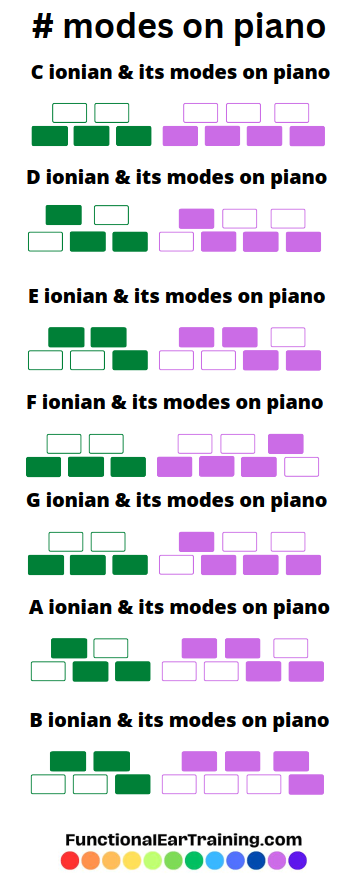
Our free downloadable chart, “# Modes on Piano,” illustrates this principle by showing the keyboard patterns of seven major scales and their corresponding modes.
The chart provides a visual reference for pianists, keyboard players, and anyone interested in understanding the relationship between major scales and diatonic modes.
Understanding the Seven Modes
Every major scale contains seven notes. By treating each of these notes as a different tonal centre, we obtain seven diatonic modes:
- Ionian – the familiar major scale
- Dorian – a minor mode with a natural sixth
- Phrygian – a minor mode with a flattened second
- Lydian – a major mode with a raised fourth
- Mixolydian – a major mode with a flattened seventh
- Aeolian – the natural minor scale
- Locrian – a diminished mode with a flattened second and fifth
These modes share the same notes when derived from the same parent major scale. However, each has a distinct musical character because the relationships between the notes and the tonal centre change.
An Example: G Major and Its Seven Modes
Consider the G major scale:
G – A – B – C – D – E – F#
These seven notes can form seven different modes:
| Mode | Notes |
|---|---|
| G Ionian | G A B C D E F# |
| A Dorian | A B C D E F# G |
| B Phrygian | B C D E F# G A |
| C Lydian | C D E F# G A B |
| D Mixolydian | D E F# G A B C |
| E Aeolian | E F# G A B C D |
| F# Locrian | F# G A B C D E |
Notice that the notes never change.
On the piano, you use exactly the same seven keys for every mode. Only the tonal centre changes.
This distinction is fundamental to functional ear training.
For example, the note C has a completely different function depending on the mode:
- In G Ionian, C is the fourth.
- In A Dorian, C is the minor third.
- In B Phrygian, C is the minor second.
- In C Lydian, C is the tonic.
- In D Mixolydian, C is the minor seventh.
The piano key remains the same, but its musical meaning changes.
What Does the Chart Show?
The downloadable chart presents the keyboard patterns of seven major scales:
- C Ionian and its modes
- D Ionian and its modes
- E Ionian and its modes
- F Ionian and its modes
- G Ionian and its modes
- A Ionian and its modes
- B Ionian and its modes
For each major scale, the illustration highlights the seven keys belonging to its diatonic note collection.
The filled keys indicate the notes of the scale, while the outlined keys represent notes outside that collection.
Each keyboard pattern applies not only to the Ionian scale but also to all six other modes derived from it.
The chart therefore helps you see that learning seven modes does not mean learning seven completely different sets of notes.
Instead, you learn one collection of seven notes and explore seven different ways of hearing and using them.
From Keyboard Patterns to Functional Ear Training
Understanding the keyboard patterns is useful, but Functional Ear Training goes one step further.
The goal is not simply to memorize which notes belong to a mode or to recognize a scale pattern on the keyboard.
The goal is to hear the function of every note in relation to a tonal centre.
A note that sounds stable in one mode may create tension in another. A note that functions as the tonic in one context becomes the third, fourth, or seventh in another.
These relationships are what give each mode its characteristic sound.
A practical way to explore this is to use a sustained drone or a suitable backing track that establishes the tonal centre.
For example, play the seven notes of G major over different drones:
- Over a G drone, you hear G Ionian.
- Over an A drone, you hear A Dorian.
- Over a B drone, you hear B Phrygian.
- Over a C drone, you hear C Lydian.
- Over a D drone, you hear D Mixolydian.
- Over an E drone, you hear E Aeolian.
- Over an F# drone, you hear F# Locrian.
The same seven piano keys produce seven different modal experiences.
Find Cello Drones in all 12 keys here
Try singing individual notes against the drone rather than simply playing scales up and down. Pay attention to how each note relates to the tonal centre.
This is the essential difference between knowing a mode theoretically and actually hearing its musical functions.
A Visual Reference for Your Practice
The “# Modes on Piano” chart can serve as a convenient reference while exploring diatonic modes at the keyboard.
It helps you identify the notes available in each scale, recognize the shared note collections of related modes, and connect theoretical knowledge with practical playing.
But remember: The keyboard shows you which notes to play. Your ear tells you what those notes mean.
That is the central idea behind Functional Ear Training.
Download the Free Piano Modes Chart
You can download the “# Modes on Piano” chart as a free PDF.
The printable chart includes seven major-scale keyboard patterns and their corresponding modal note collections.
Use it alongside your piano, keyboard, or functional ear training exercises to explore how seven notes can create seven different tonal worlds.

FunctionalEarTraining.com – Learn to hear the function of every note.
