
Seven Chords, Seven Notes, One Tonal Reference
When learning music theory, we usually encounter the seven diatonic chords of the major scale as a sequence of chord types: major, minor, dominant, and diminished.
We learn that the first degree produces a major seventh chord, the second a minor seventh chord, the fifth a dominant seventh chord, and so on.
This is useful theoretical knowledge. But from the perspective of Functional Ear Training (FET), there is another, particularly interesting way to understand these chords.
Instead of looking at each chord as a separate collection of intervals, we can examine how all seven chords are constructed from the same seven notes.
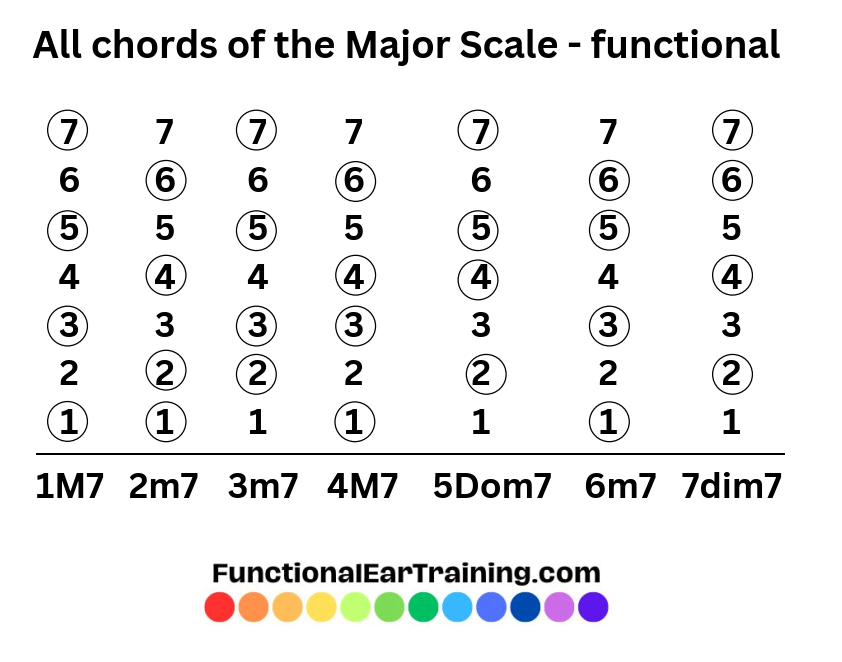
The diagram All Chords of the Major Scale – Functional, available for download at the end of this article, illustrates this principle.
The Seven Notes Remain the Same
Consider the C major scale:
C – D – E – F – G – A – B
In Functional Ear Training, we represent these notes by their scale degrees:
1 – 2 – 3 – 4 – 5 – 6 – 7
Each number represents a specific note in relation to the tonal reference, C.
- 1 = C
- 2 = D
- 3 = E
- 4 = F
- 5 = G
- 6 = A
- 7 = B
These relationships form the foundation of functional listening.
Now consider what happens when we construct seventh chords on each degree of the major scale.
Although the chords change, the seven available notes remain exactly the same.
How the Seven Diatonic Chords Are Constructed
Each diatonic seventh chord consists of four notes, obtained by stacking thirds within the scale.
The following table shows the seven chords and their functional notes.
| Chord | Functional Notes | Example in C Major |
|---|---|---|
| 1M7 | 1 – 3 – 5 – 7 | C – E – G – B |
| 2m7 | 2 – 4 – 6 – 1 | D – F – A – C |
| 3m7 | 3 – 5 – 7 – 2 | E – G – B – D |
| 4M7 | 4 – 6 – 1 – 3 | F – A – C – E |
| 5Dom7 | 5 – 7 – 2 – 4 | G – B – D – F |
| 6m7 | 6 – 1 – 3 – 5 | A – C – E – G |
| 7m7♭5 | 7 – 2 – 4 – 6 | B – D – F – A |
The seventh chord is technically half-diminished (m7♭5), rather than a fully diminished seventh chord.
The important observation is that no new notes are introduced.
Every chord is simply a different combination of four notes from the same seven-note collection.
The Difference Between Chord Intervals and Functional Notes
This distinction is fundamental to understanding the diagram.
In conventional chord theory, we describe notes according to their intervals above the root of the current chord.
For example, the notes of Dm7 are:
D – F – A – C
Relative to D, these are:
Root – Minor Third – Perfect Fifth – Minor Seventh
But Functional Ear Training uses a different reference.
If we remain in C major, those same notes are:
2 – 4 – 6 – 1
The note D is still scale degree 2, even though it is the root of Dm7.
Similarly, C remains scale degree 1, although it functions as the seventh of Dm7.
This gives us two different ways of describing the same musical material:
Chord perspective: What is the interval of this note relative to the current chord root?
Functional perspective: What is the position of this note within the underlying major scale?
Both perspectives are musically useful. However, Functional Ear Training deliberately emphasizes the second.
One Note, Different Chord Roles
Consider the note C in the key of C major.
Depending on the chord being played, C assumes different harmonic roles.
| Chord | Role of C |
|---|---|
| CMaj7 | Root |
| Dm7 | Minor Seventh |
| FMaj7 | Perfect Fifth |
| Am7 | Minor Third |
From the perspective of chord theory, C changes its intervallic role four times.
From the perspective of FET, however, C remains scale degree 1 throughout.
This distinction becomes especially useful when learning to sing or improvise over chord progressions.
Instead of constantly recalculating every note relative to a new chord root, we can maintain a consistent tonal reference while listening to how the harmonic context changes.
The note remains familiar, but its relationship to the harmony becomes different.
The Connection to the Seven Modes
The same principle applies to modal music.
The seven modes of a major scale use exactly the same seven notes, but organize them around different tonal centers.
In C major, the corresponding modes are:
| Mode | Tonal Center | Associated Chord |
|---|---|---|
| Ionian | C (1) | CMaj7 |
| Dorian | D (2) | Dm7 |
| Phrygian | E (3) | Em7 |
| Lydian | F (4) | FMaj7 |
| Mixolydian | G (5) | G7 |
| Aeolian | A (6) | Am7 |
| Locrian | B (7) | Bm7♭5 |
The association between a mode and its characteristic seventh chord is particularly useful for modal practice.
However, playing a particular chord does not automatically establish the corresponding mode. The actual tonal center depends on the musical context.
In the FET approach, the crucial point is that we do not need to learn seven entirely different collections of notes.
We learn one collection of seven functional notes and experience it in seven different modal contexts.
For example, when practicing D Dorian using the notes of C major, D becomes the modal tonal center. Nevertheless, within the functional reference system, D continues to be represented by 2.
This principle lies at the heart of the revised FET Level 1 concept.
What This Means for Functional Ear Training
Traditional approaches to ear training often focus on identifying intervals, chord qualities, or chord progressions.
Functional Ear Training takes a different approach.
Its primary goal is to develop the ability to recognize, sing, and use individual notes according to their position within a tonal framework.
Once the seven functional notes are familiar, they can be practiced in different harmonic contexts.
For example, when practicing over the IV chord, the chord tones are:
4 – 6 – 1 – 3
Over the V chord, they are:
5 – 7 – 2 – 4
And over the vi chord:
6 – 1 – 3 – 5
The challenge is not to identify the chord by ear. Instead, the student learns which functional notes belong to the chord and practices using them over an appropriate accompaniment.
The remaining scale notes can also be used melodically. Their relationship to the chord, including their potential tension and resolution, becomes part of the musical experience.
This creates a direct connection between functional hearing, harmony, and practical music-making.
From Ear Training to Musical Application
The diagram also suggests a practical way to integrate chord practice into FET Level 1.
Start with a familiar major scale and its seven functional notes.
Then select one of the diatonic chords and practice singing or playing its four chord tones while an accompaniment establishes the harmonic context.
For example:
Over 2m7: 2 – 4 – 6 – 1
Over 5Dom7: 5 – 7 – 2 – 4
Over 1M7: 1 – 3 – 5 – 7
Gradually, these note combinations become familiar within their respective harmonic contexts.
The same approach can be extended to chord progressions.
For example, a ii–V–I progression in C major consists of:
- Dm7: 2 – 4 – 6 – 1
- G7: 5 – 7 – 2 – 4
- CMaj7: 1 – 3 – 5 – 7
Throughout the progression, the functional reference remains unchanged.
This does not eliminate the need to understand chord-specific intervals. Rather, it provides an additional perspective that connects harmonic knowledge with the functional hearing skills developed through FET.
One System, Twelve Keys
Although the examples above use C major, the same relationships apply to all twelve keys.
The functional structure of the chords does not change when we transpose.
The second-degree minor seventh chord always contains:
2 – 4 – 6 – 1
The fifth-degree dominant seventh chord always contains:
5 – 7 – 2 – 4
And the first-degree major seventh chord always contains:
1 – 3 – 5 – 7
Only the absolute pitches change.
This consistency is one of the main advantages of working with functional scale degrees rather than memorizing separate note names and chord tones for every key.
It also explains why the new FET Level 1 training materials are being organized around all twelve keys, with each key providing a foundation for exploring all seven modes and their associated diatonic chords.
Conclusion: Understanding Harmony Through Functional Relationships
The seven diatonic seventh chords may initially appear to be seven different harmonic structures that need to be learned individually.
But from a functional perspective, they reveal an underlying simplicity:
Seven notes form seven different seventh chords, and each note retains its position within the underlying major scale.
The harmonic role of a note can change from chord to chord. Its functional identity within the reference scale remains the same.
Understanding this distinction provides a useful foundation for connecting functional ear training with modal playing, chord tones, and improvisation.
The accompanying diagram offers a visual overview of these relationships and can serve as a reference during practice.
Download the Free Chord Diagram and irealPro files
All Chords of the Major Scale – Functional
Download the diagram as a PDF and use it as a reference when practicing the seven diatonic seventh chords, their functional notes, and their connections to the seven modes.

Practice all chords with iRealPro

Practice the Three Diatonic Minor Chords
To put these functional relationships into practice, you can use the backing tracks from Diatonic Minor Chords Only on Bandcamp.
These tracks focus on the three minor seventh chords of the major scale:
- 2m7: 2 – 4 – 6 – 1
- 3m7: 3 – 5 – 7 – 2
- 6m7: 6 – 1 – 3 – 5
Practice singing or playing the four chord tones over the corresponding accompaniment while maintaining the functional reference to the underlying major scale. Then explore the remaining diatonic notes and listen to how their harmonic relationships change.
Listen to the Backing Tracks on Bandcamp
FunctionalEarTraining.com – Learn to Hear the Function of Every Note.
