
Seven Notes, Seven Modes – One Diatonic Scale
One of the fundamental principles of Functional Ear Training is that every major scale contains seven notes, and these same seven notes can be used to create seven different modes.
The notes themselves do not change. What changes is their tonal function, depending on which note becomes the tonal centre.
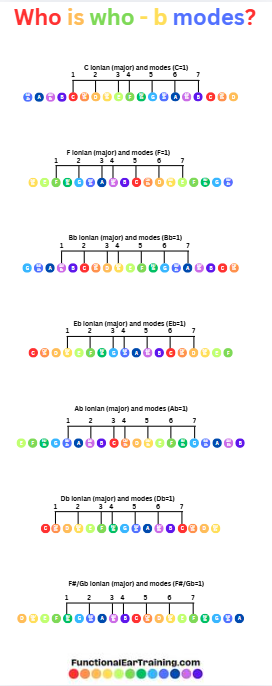
Our downloadable chart, “Who Is Who – ♭ Modes?”, provides a visual overview of the diatonic notes in seven major keys, from C major through the flat keys to Gb major.
It shows exactly where the seven notes of each scale are located within the chromatic scale.
Understanding the Chart
The chart presents seven major scales:
- C major – no sharps or flats
- F major – 1 flat
- Bb major – 2 flats
- Eb major – 3 flats
- Ab major – 4 flats
- Db major – 5 flats
- Gb major – 6 flats
Each horizontal row displays a section of the chromatic scale, with individual notes represented by coloured circles.
The seven notes belonging to the respective major scale are identified by a black bracket and numbered from 1 to 7.
The remaining chromatic notes are also visible, making it easy to see how each diatonic scale fits into the twelve-note chromatic system.
As you move through the flat keys, one additional note is lowered at each step.
One Scale – Seven Different Modes
Let’s take F major as an example.
The seven notes are:
F – G – A – Bb – C – D – E
These seven notes form the basis of seven different modes:
| Mode | Tonal Centre | Notes |
|---|---|---|
| F Ionian | F | F G A Bb C D E |
| G Dorian | G | G A Bb C D E F |
| A Phrygian | A | A Bb C D E F G |
| Bb Lydian | Bb | Bb C D E F G A |
| C Mixolydian | C | C D E F G A Bb |
| D Aeolian | D | D E F G A Bb C |
| E Locrian | E | E F G A Bb C D |
All seven modes contain exactly the same notes.
However, they do not sound the same.
When F is the tonal centre, we hear F Ionian, the familiar major scale. When D becomes the tonal centre, the same notes produce D Aeolian, the natural minor scale.
The characteristic sound of each mode comes from the relationship between its notes and its tonal centre.
This distinction between absolute pitch and tonal function is central to Functional Ear Training.
Why the Chromatic Perspective Matters
Traditional scale charts usually present each major scale as a sequence of seven notes.
Our chart takes a slightly different approach.
By showing the complete chromatic surroundings of each scale, it makes the relationship between the seven diatonic notes and the remaining five chromatic notes visible.
This helps distinguish two important concepts:
The chromatic scale contains twelve different pitch classes within an octave.
A diatonic scale selects seven of these twelve pitch classes according to a specific pattern of whole steps and half steps.
In the major scale, this pattern is:
Whole – Whole – Half – Whole – Whole – Whole – Half
Regardless of the key, the pattern remains identical.
The diagram also uses consistent colours for the chromatic pitches, making it easier to compare the different scales visually.
From Understanding Scales to Hearing Tonal Functions
Knowing which notes belong to a scale is useful. But knowing the notes intellectually is not the same as hearing their tonal functions.
Functional Ear Training focuses on developing the ability to recognise and sing notes in relation to a tonal context.
For example, the note C can fulfil very different functions:
- In C Ionian, C is the tonal centre.
- In F Ionian, C is the fifth scale degree.
- In Bb Ionian, C is the second scale degree.
- In Ab Ionian, C is the third scale degree.
The absolute pitch remains the same, but its musical function changes.
The same principle applies to modal training.
When you practise the seven modes of a particular diatonic scale, you work with the same seven notes while learning to hear different tonal centres.
The goal is not simply to memorise seven different note sequences. It is to develop an auditory understanding of how notes function within different tonal contexts.
A Visual Reference for Your Ear Training
The “Who Is Who – ♭ Modes?” chart can serve as a reference when studying the flat keys and their related modes.
It helps you identify the seven diatonic notes of each key, compare their positions within the chromatic scale, and understand why seven different modes can share exactly the same note material.
The chart is particularly useful alongside practical ear training exercises, where the theoretical relationships become audible.
Ultimately, the purpose of Functional Ear Training is not just to know which notes belong to a scale, but to hear what those notes mean within a tonal context.
Free Download: Who Is Who – ♭ Modes?
Download the printable chart “Who Is Who – ♭ Modes?” and use it as a visual reference for studying the seven diatonic notes and their modes in C, F, Bb, Eb, Ab, Db, and F#/Gb.

Practice all modes with iRealPro files:

For an overview of the sharo keys, see our companion chart, “Who Is Who – ♭ Modes?”
Practice All Seven Modes with Cello Drones
You can practise all seven modes using our Cello Drones on Bandcamp. The principle is simple: always choose the drone that matches the tonal centre of the mode you want to practise. For example, to practise Eb Dorian, use the Eb drone. To practise F# Mixolydian, use the F# drone. The drone establishes a stable tonal centre, allowing you to explore the characteristic sound of each mode by singing or playing its notes against that reference pitch. This helps you experience how the same seven diatonic notes can produce different modal sounds depending on which note functions as the tonal centre.
FunctionalEarTraining.com – Learn to hear the function of every note.
